Wednesday, 19 February 2014

Are Shropshire’s floods caused by climate change?

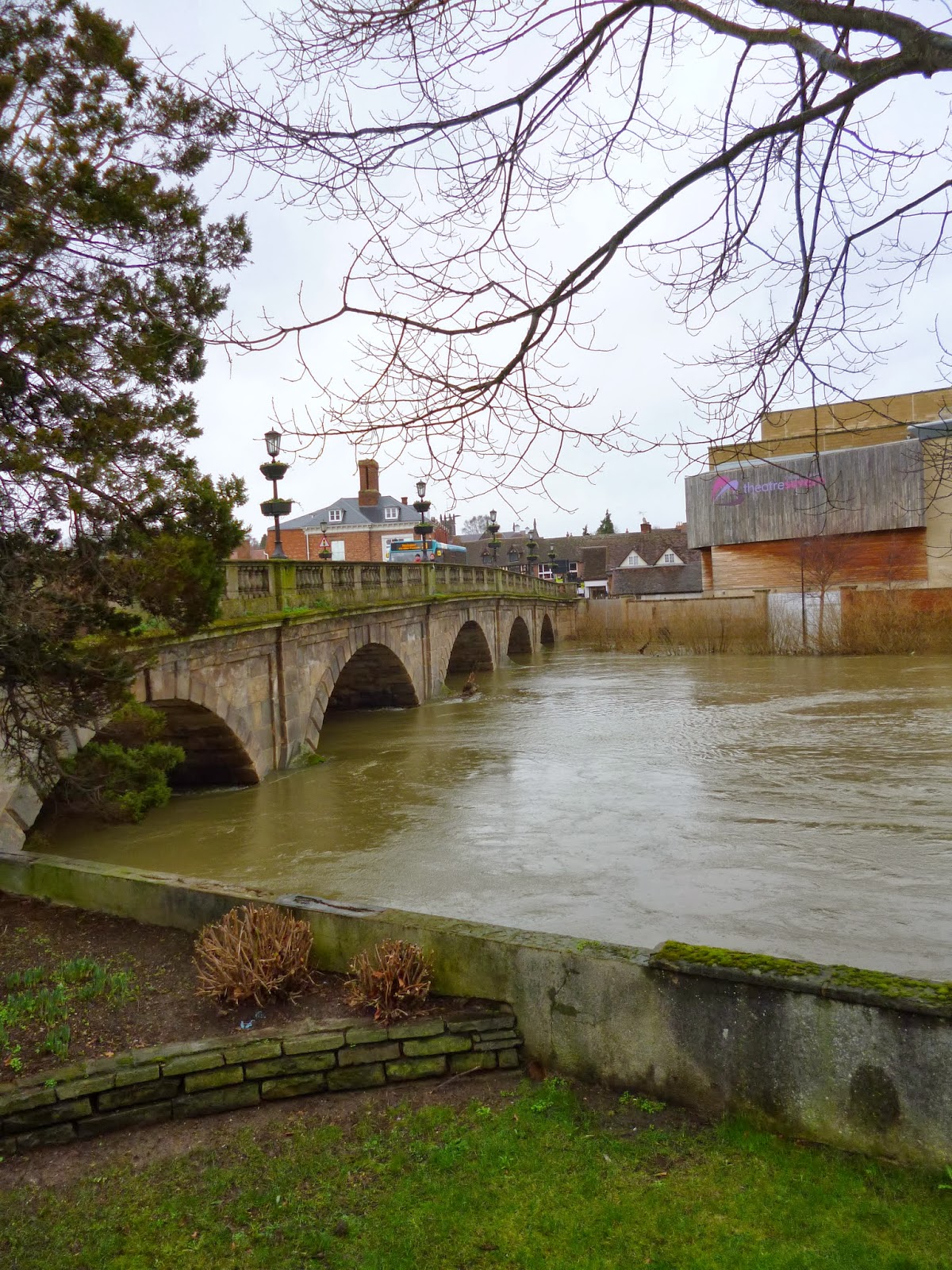
The very high River Severn at Shrewsbury.
Shropshire has been battered by heavy rain and strong winds over the last week, as two storms passed over the county within a few days of each other. Hundreds of trees fell (Shropshire Star, 2014a), including one in my garden. With the ground already saturated thanks to months of wet weather, the already swollen River Severn burst its banks at Shrewsbury and Ironbridge, damaging houses (Shropshire Star, 2014b).  

A fallen tree on Haughmond Hill.
This has been the wettest January on record for Britain (Carrington, 2014), so the recent weather is out of the ordinary. But is it part of the normal variation from year to year that we would expect, or has it been caused by climate change? And if so, are we likely to experience this kind of wet and windy weather more often in the future?

What is climate change?
The climate change we are experiencing now is caused by an increase in greenhouse gases in the atmosphere. These gases absorb heat from the sun, warming up the air, and therefore the land or water below. Burning fossil fuels to heat our homes or generate electricity causes more carbon dioxide – a key greenhouse gas – to be produced, and destroying forests or other vegetation means that less carbon dioxide is removed from the atmosphere through photosynthesis. With more carbon dioxide entering the system than is being removed, the concentration has risen from 278 parts per million (ppm) in the pre-industrial period to 400 ppm today. In turn, the global mean temperature has increased around 0.8°C over the same period (World Bank, 2012).

Climate change and rain
Increasing the temperature of the atmosphere affects rainfall patterns across the world, both in the amount and location of rain. This is because the warmer it is, the more water evaporates from the surface of the earth, and also the more water vapour the air can hold – the water-holding capacity of the atmosphere increases by 7% for every 1 °C increase in temperature (Trenberth, 2011).  It is thought that the net effect of this “speeding up” of the water cycle will be that dry areas of the world will get drier, and wet areas of the world will get wetter (World Bank, 2012). With Britain already famous for its drizzly weather, it seems likely that Shropshire will receive more rain rather than less.

Scientists use climate models to simulate the effect of increasing carbon dioxide levels on precipitation. A study by NASA (2013) using 14 models showed that not only will there be more rain in wet areas across the course of a year, the pattern of rainfall will change so that there are more days with heavy rain and fewer with moderate rain. The latest report from the UN’s Intergovernmental Panel on Climate Change (IPCC, 2013) states that by the late 21st century, it is very likely that heavy precipitation events will occur more often and more strongly in areas of the world like Europe.

So, in the future our wet weather will come in shorter bursts, making it more difficult for natural drainage systems to cope and river flooding more likely. A study by Ciscar et al (2011) showed that if global average temperatures increased by 2.9 °C above industrial levels, 12,000 people would be affected by river flooding in northern Britain. If temperatures rise by 3.9 °C, this figure rises to 48,000.

Were these storms caused by climate change?

Shrewsbury's Theatre Severn's flood defences held out. 
Climate change is a long process that has many different and overlapping effects. It is therefore very difficult to blame any specific weather event on it, and instead scientists talk about particular aspects of weather being more or less likely in a warmer world. However, this has not stopped politicians and some public figures making statements in the last few weeks either attributing this unusual British weather to climate change, or actively denying it (Shuckman, 2014).

Interestingly, while there is evidence that specific instances of very heavy rain in the last few years are due to climate change, evidence surrounding storms specifically is less clear (Coumou and Rahmstorf, 2012).

Conclusion
Scientific evidence suggests that the unusually high rainfall levels we have experienced in the last few months may become less unusual in the future, as increasing global temperatures make Britain an even rainier place. While we cannot lay definitive blame for the storms of the last week on climate change, as we move forward we may see clearer patterns emerging. After all, the climate is really a collection of all our weather, so we must expect the weather to change unless we reduce carbon emissions drastically.

References

Carrington D (2014) ‘January was England’s wettest winter month in almost 250 years’, The Observer, 01/02/14. Available at www.theguardian.com/uk-news/2014/feb/01/january-uk-wettest-winter-month-250-years

Ciscar J, Iglesias A, Feyen L, Szabó L, Regemorter D V and Amelung B (2011) ‘Physical and economic consequences of climate change in Europe’, Proceedings of the National Academy of Sciences of the United States of America. Available at: http://www.pnas.org/content/108/7/2678.full

Coumou D and Rahmstorf S (2012) ‘A decade of weather extremes’, Nature Climate Change, 2, 491-496. Available at: http://www.nature.com/nclimate/journal/v2/n7/full/nclimate1452.html

IPCC (2013) Climate change 2013 – the physical science basis: Summary for policymakers. Available at: https://www.ipcc.ch/report/ar5/wg1/docs/WG1AR5_SPM_FINAL.pdf

NASA (2013) NASA study projects warming-driven changes in global rainfall. Available at: www.nasa.gov/home/hqnews/2013/may/HQ_13-119_Rainfall_Response.html

Shropshire Star (2014a) ‘Hundreds of trees felled by the storms’, Shropshire Star, 14/02/14. Available at: www.shropshirestar.com/news/2014/02/14/hundreds-of-trees-felled-by-shropshire-storm/

Shropshire Star (2014b) ‘Ironbridge residents urged to move out over flooding’, Shropshire Star, 11/02/14. Available at: www.shropshirestar.com/news/2014/02/11/waters-rising-as-floods-swamp-shropshire/

Shukman D (2014) Barrage over climage change link to floods. Available at: http://www.bbc.co.uk/news/science-environment-26242253

Trenberth K (2011) Changes in precipitation with climate change, Climate Research vol 47: 123-138. Available at: www.int-res.com/articles/cr_oa/c047p123.pdf

World Bank (2012) Turn Down the Heat – Why a 4 °C warmer world must be avoided. Available at: www.worldbank.org/en/news/feature/2012/11/18/Climate-change-report-warns-dramatically-warmer-world-this-century

Thursday, 12 December 2013

Film review - The Secret Life of Walter Mitty


Walter Mitty – writer James Thurber's dull everyman, who in his fantasies is a hero famed for his derring-do – is one of those rare characters who has had a psychological complex named after him. Ben Stiller's new version takes this basic idea as a starting point, but moves very far away from the original tale. The result is not wholly successful.

Walter (played by Stiller himself) works at Life magazine, locked in the negatives department but dreaming of a more exciting life with one of his co-workers (Kristen Wiig). When the new owners of Time Life decide to close the title, Walter receives a package from a mysterious photojournalist (Sean Penn) supposedly containing the perfect photo for the last issue's cover. Unfortunately, the photo is missing. In an effort to find it, Walter embarks on a journey that will change his life.


This is essentially a very sweet film about finding yourself and those you love, and you can tell that it is a very personal project for Stiller. It is also very beautiful to look at, with gorgeous shots taken in parts of the world that Hollywood very rarely explores. Stiller is in his best straight man mode, Wiig is adorable as always, and all the performances are solid. There are some problems, though.

Firstly, I would question the need for this to be called a Walter Mitty film at all. Mitty's fantasies occur mostly early on, and are not necessary for the plot at all. They are also some of the least enjoyable parts of the film. Since the original story was written, dream sequences have become such a cliché, and I suppose it doesn’t help that I personally had my fill around 2001 when TV was full of them. They ruined the otherwise perfect Sopranos, and I’m sorry, but if Ally McBeal was really seeing a dancing baby, she is suffering from serious psychosis and needs to be hospitalised.  It does not mean that she is "ditzy".

Although I didn’t like the fantasies, if they have to stay you almost need more of them to properly set up Walter’s world. While watching this, I had a feeling that a lot had been cut out to shorten the running time, and perhaps some fantasy bits had to go; more worryingly, there were a few times when characters referred to things that hadn’t happened earlier in the film, or the plot seemed fuzzy.

And what a plot it is! I must say, it is the most specific plot I have seen for a while, with Walter working for a specific magazine (another problem with the film – too much product placement) in a very specific job, looking for a very specific McGuffin in some very specific places. It is also extremely surreal and basically completely ridiculous, requiring a liberal amount of belief suspension from the audience. It must be remembered, though, that while on the surface this is a big studio comedy, it really is an indie at heart, and most reminded me in tone of Eternal Sunshine of the Spotless Mind.

All in all, Stiller's take on The Secret Life of Walter Mitty is moving, and it is funny at times. There was just something stopping me completely going along with Walter's journey of discovery. Perhaps I'm just not enough of a dreamer to understand.

Sunday, 27 October 2013

London Film Festival review - The Spectacular Now


This indie coming of age tale provides an interesting counterpoint to Superbad. Both films are about a confident, mouthy, academically unremarkable high school senior who concentrates on drinking and partying to avoid contemplating the future. The Spectacular Now takes a much more serious look at this condition, and at times is truly heart breaking.

Sutter Keely (Miles Teller) thought he had it all – a great girlfriend, a job, a car. But when his girlfriend leaves him, his latent alcoholism and lack of direction become harder to hide. He meets Amy (Shailene Woodley), a good girl who really should know better than to go out with him, and love begins to blossom. But will Sutter allow himself to be happy?

Both leads are excellent, and look young and normal enough to make you feel they are real. The script (from the writers of 500 Days of Summer) is a lovely mix of funny and poignant. Amazingly, the film lasts only 95 minutes but feels much longer (in a good way), with ample time to breathe.

A quick look at director James Ponsoldt’s CV shows that all three of his films so far have been about alcoholics. This is obviously a subject close to his heart, and it shows in the sensitivity with which he treats the characters. The Spectacular Now is a sweet film, which while it doesn't particularly break new ground, takes you on an engrossing journey.

Saturday, 26 October 2013

London Film Festival review - En Som Deg (Must Have Been Love)


Eirik Svensson's debut feature is a low-key, poetic romance that is more about loneliness than love. The film opens in Istanbul, where Kaisa (a Finnish girl) meets Jakob (a Norwegian guy) on holiday. They have an instant connection, but he leaves before they can swap mobile numbers, or even tell each other their surnames. When she moves to Oslo, she bumps into Andreas, who looks a lot like Jakob, and begins a relationship with him. But he just isn't the same.

What is lovely about this film is how naturalistic the conversations are. Unafraid of using silence, the characters talk to each other in awkward English and much of what is said is through the eyes.

And what eyes. Pamela Tola is luminous as Kaisa. Alone in a new city, we can feel her longing for warmth and familiarity. Espen Klouman-Høiner does an amazing job of playing two characters – I really didn't realise he was both Jakob and Andreas until I saw the credits (though that may have been because Klouman-Høiner looks 10 times more attractive without a moustache than with one).

The cinematography is beautiful – all four featured cities are crisply realised in muted tones. A soundtrack full of acoustic Nordic folk rock matches this perfectly.

This is a film where very little happens, but what does happen means a lot. It explores how people can project their past onto those around them, seeing what they want to see instead of what is there. Ok – so of course I wanted them to just friend each other on Facebook, which would have instantly solved all their problems, but I still enjoyed this quiet and heartfelt journey.

London Film Festival review - All Cheerleaders Die

Sianoa Smit-McPhee and Caitlin Stasey vamping it up.

Do you like zombies? Do you like vampires? Cheerleaders? Lesbian witches? If the answer is yes, then this is the gloriously demented film for you.

Maddy (Caitlin Stasey) is a beautiful outsider in her high school who has vowed to take revenge on the popular kids. When she infiltrates the cheerleader squad, she inadvertently sparks off a series of very unfortunate events that leave her and her teammates undead and thirsty for blood.

This film is a mishmash of tones, genres and stereotypes – and you can definitely see the joins. Frenetically lurching from one set piece to another, with little logic in-between, it is a wild ride for those happy to surrender to its many charms and ignore its many shortcomings.

All the girls in this film are a hoot – gorgeous, but with a lot more character than your usual bland horror beauties (Australian Stasey is certainly pretty and sassy enough to be a star). The script has some hilarious lines, and the soundtrack is as loud and brash as it could possibly be.  

This All Cheerleaders Die is actually a bigger-budget remake of directors Lucky McKee and Chris Sivertson’s first film (though the new budget could only stretch to some very ropey special effects). By all accounts, the pair followed the original with a string of iffy horrors. Second time around, they have still not created a “good” film, but it has a certain kind of brilliance.

Easily the stupidest, weirdest and most fun film I have seen this year, All Cheerleaders Die is a cult classic in the making.

Monday, 28 January 2013

Film review - Django Unchained


After the disappointment of Inglorious Basterds, I wasn’t really looking forward to seeing Tarantino’s latest offering, so I suppose I can no longer call myself The World’s Biggest Tarantino Fan™. I needn’t have worried, though, as Django Unchained avoids (almost) all of the ridiculous, poorly-judged moments of Basterds and is a thoroughly entertaining epic with a poetic script. It also manages to depict slavery in a more interesting and (I can’t quite say accurate, so I’ll say…) appropriate way than one might expect.

The setting is the Deep South in the 1850s. Verbose German bounty hunter Dr King Schultz (Christoph Waltz) buys a slave named Django (Jamie Foxx) because he can recognise the faces of three wanted men. Django quickly shows natural flair for the bounty hunting business, so the two partner up to kill the South’s worst offenders and to rescue Django’s beloved wife Broomhilda (Kerry Washington).

Quentin’s script is detailed, funny and shows his brilliant use of language. He is most famous for his chats about American popular culture, and in Inglorious Basterds these became chats about German cinema of the 1930s. As this is his first film set before the moving image, he has had to forego all that, making Django Unchained feel a little less referential and arch than his other films.

Instead we have the wonderful Christoph Waltz rat-a-tat-tatting through line after line of flowery prose. His character really is the best thing about this film – a charming, cunning murderer with morals. Why he is nominated again for best supporting actor rather than full actor, I do not know. Foxx’s Django is a tower of quiet strength, and he is impressive in the role, but Waltz is on screen just as much and has a lot more to say.

Perhaps the most surprising performance comes from Samuel L. Jackson, who is almost unrecognisable as an elderly house slave. He’s the one who should have been nominated for best supporting actor. The part is quite small but crucial, and asks uncomfortable questions. And he plays it exquisitely.

Slavery is an issue that is hardly explored in cinema. Apart from a few worthy films that focus on it, it is generally glossed over in tales of the Old South, or just given a gentle nod to make sure we know the filmmakers are aware of it. Here it is integral to the plot, but it isn’t the plot alone. And it is shown to be brutal in the extreme – Tarantino isn’t taking the subject lightly, as Spike Lee presumed without seeing the film. Although he is often accused of making violence seem fun, the violence inflicted on the slaves is that other type of Tarantino violence – shocking, real and deeply unsettling.

Unfortunately, the film does go downhill a bit at the end. After a wonderful build-up of tension we get a lot of silly shootouts. These go on for too long and aren’t as beautiful, or cool as any of the sequences in Kill Bill, and instead are a bit jokey. Of course the redemptive aspect to the violence is nice, but if it was done in a more majestic way, it would have been the ending the film deserved.

Which brings me to the one truly stupid bit of the movie. A scene which took me completely out of the story and made me truly despair of my favourite director. It is the scene close to the end in which he plays an Australian ranch hand.

An Australian.

In 1850s Mississippi.

I’m not going to take cheap shots at Tarantino’s acting ability (I actually like him in From Dusk Till Dawn and Pulp Fiction), but it isn’t even a good Australian accent.

Some switch must have flipped in Quentin’s head in 2008, and he can no longer tell when an idea is good or hideously embarrassing. This is why he is playing an Australian here, and why the whole scene with Mike Myers in Inglorious Basterds exists. If he had been walking this tightrope in 1994, one step to the left and he’d have had Jules and Vincent whacking each other over the head like the Three Stooges before bringing Brett breakfast.

So, if you ignore that bit, Django Unchained is a very enjoyable cinema experience. It does not reach the majestic highs of a few scenes in Inglorious Basterds, but it doesn’t sink to that film’s lows either. There are no truly great Tarantino moments, but this is mature filmmaking with only a smattering of self-indulgent childishness.  

Saturday, 19 January 2013

Film review - The Hobbit: An Unexpected Journey


I am not a Lord of the Rings fan. Kevin Smith got it right when he described them as “three movies about walking to a fucking volcano”. So I was not looking forward to ruining another three Christmases in a row with Peter Jackson’s new endurance tests. Yet somehow I quite enjoyed The Hobbit: An Unexpected Journey.

Maybe it was because Cate Blanchett’s celestial droning was kept to a bare minimum. Maybe it was because Martin Freeman got to use Tim from The Office’s “Really?” face in a scene with Gollum. Maybe it was because I feel more kindly to Peter Jackson after watching West of Memphis. Whatever the reason, I wasn’t bored half to death.

The film tells the first part of Bilbo Baggins’s epic adventure helping the dwarves of Erebor regain their kingdom from the fearsome dragon Smaug. All the great effects, scenery and cinematography from the Lord of the Ring films are here again, and the cast give good performances. I particularly enjoyed the scenes with Sylvester McCoy’s Radagast the Brown (I believe these did not appear in the original book, so I risk the wrath of Tolkien geeks by saying that).

My problem with LOTR was not that they were bad films, just that they went on and on and on. If you are mesmerised by this universe, you want as much detail as possible and every incident from the books to be shown on screen. If you are not, it can be quite punishing. The Hobbit is a lot lighter in tone, reflecting its origin as a children’s book. Here you get the quality from LOTR with added fun.

Yes some scenes could probably have been shortened, and yes I am concerned about how another two films are going to be strung out of this one, reasonably short, book. But I will not roll my eyes when my family suggest seeing The Hobbit: The Desolation of Smaug next Christmas. I might even be the one to suggest it.